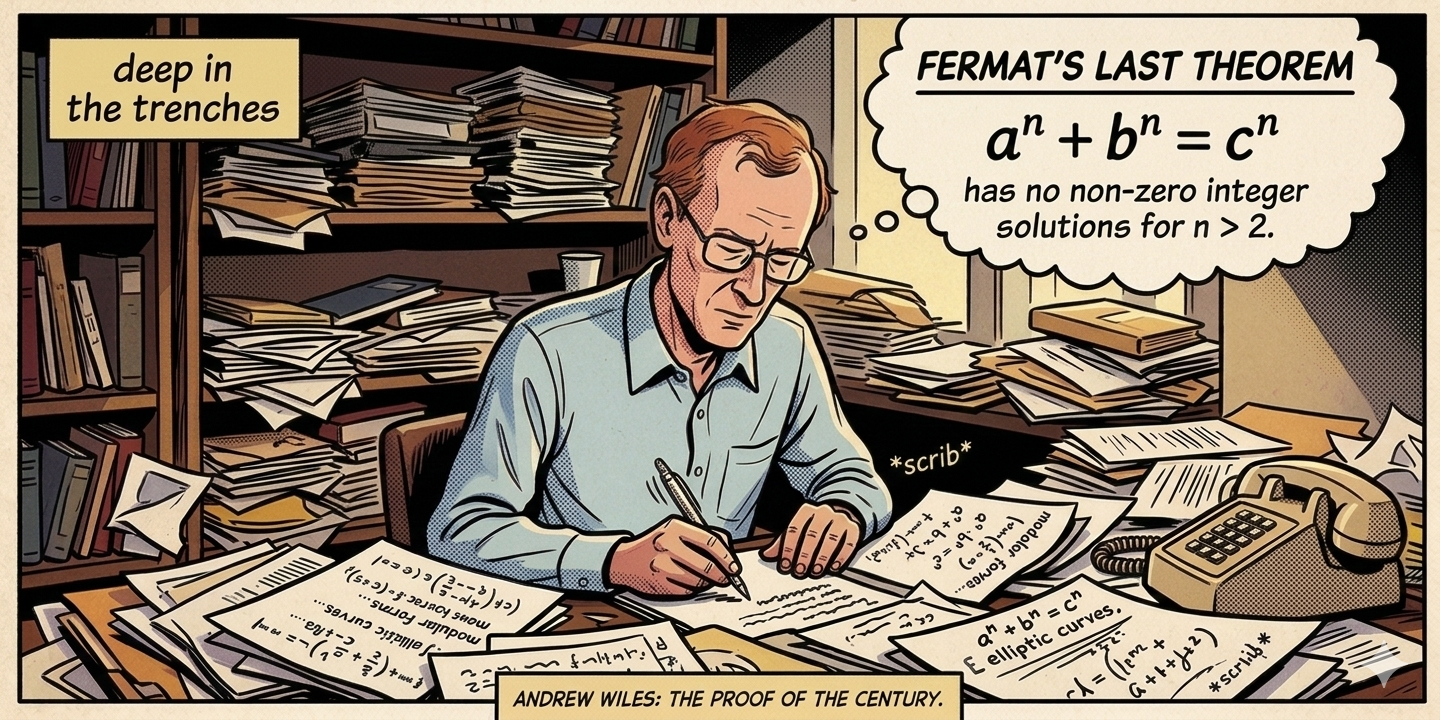

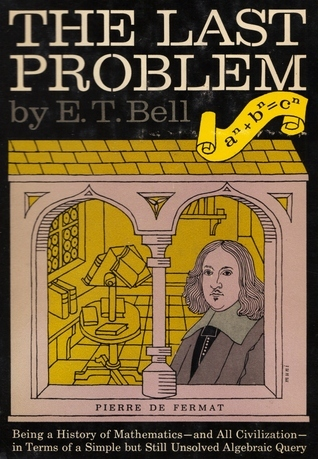
Andrew WIles was a puzzle-loving ten year old when he came across Fermat’s Last Theorem in a book in his local library. He was ten when he decided that he would be the one to discover the proof that Fermat had claimed credit for and written as much in the margins of a book 300 years before… alongside a note that there was simply not enough space in that margin to add the proof itself… Fermat died, leaving the world’s mathematicians seeking for over 300 years this enigmatic proof, known as the hardest math problem in the world.
“If you can, find problems you enjoy and work on then. It doesn’t matter if you never solve them. It is developing a habit.”
Andrew Wiles
Andrew Wiles worked for years upon years, in his spare time, in secret. He was 40 when he presented his initial proof to an audience of mathematicians. He was also 40 when it was discovered by his mathematician peers that there was a flaw in his proof. A very public mistake.
Andrew Wiles was 41 and on the verge of admitting defeat when he finally corrected his proof and formally became known as the man who solved the world’s hardest problem.
He certainly didn’t do it flawlessly or quickly. He is not celebrated for the speed and accuracy many equate with “being good at math.” He is celebrated because he persisted. He struggled. In fact, Wiles has stated that “Mathematicians struggle with mathematics even more than the general public does … we are used ot it so we learned how to adapt to that struggle.”
Wiles got stuck. “It is part of being mathematican… being stuck,” he has said. “You are stuck for five years on a problem or for a few hours.” He compares the experience of getting unstuck as coming upon a Capability Brown garden: “The surprise element of suddenly seeing everything clarified and beautiful that we feel as mathematicians.”
Though proud of his achievement, Wiles mourns the process…. and equates his triumphant solution with a simultaneous sense of loss! When asked what is next, Wiles has brought up Bernhard Riemann’s 1859 Hypothesis… You see, a true mathematician is first and foremost a seeker of problems, and second a solver of them.
[…] When put this way, the students didn’t feel like the question was simply looking for an answer. And that’s the thing. (See, the answer is the easy part.) The articulation of the strategy is where the real thinking lives, and it’s a skill that will follow them into third and fourth grade and beyond. A huge part of math is the communication of ideas. Just ask Andrew Wiles, who spent years decoding a margin note that Fermat scrawled centuries ago, and changed the world of mathematics in the process. (More on that here.) […]
[…] mistakes and moments of not knowing make up a large percentage of the work. I constantly bring up Andrew Wiles, who made one of the most famous and high profile errors in the history of public-facing math when […]