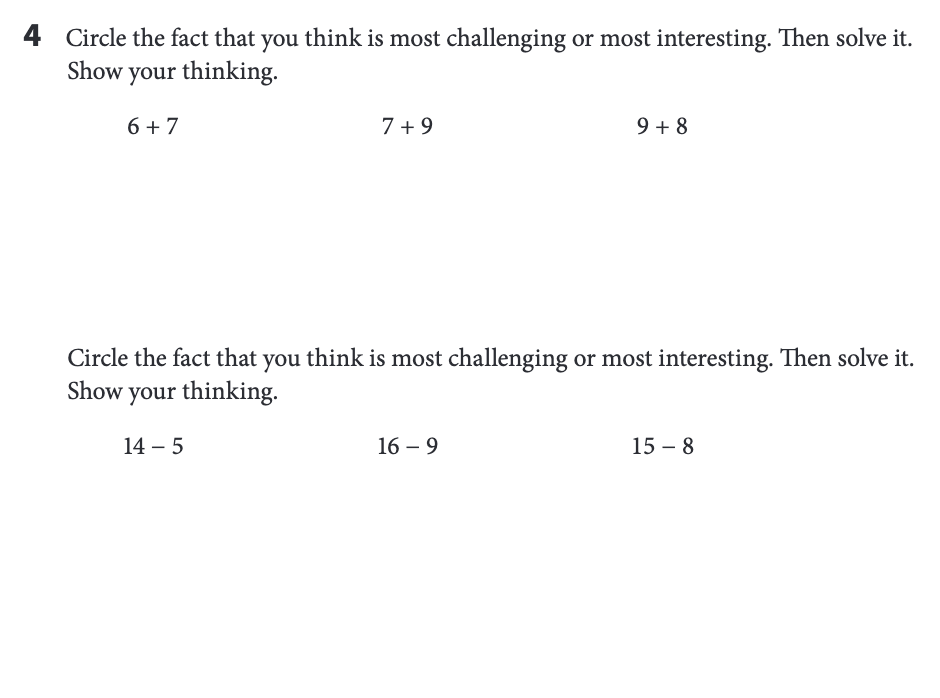

This is what I asked my second graders when reviewing their homework assignment, which included a question asking them to choose one of three basic addition facts and one of three basic subtraction facts that they found interesting or perhaps more complex than they first appeared.
I wanted them to approach it from an angle of ownership. After six months of work on addition and subtraction, rooted in flexible thinking and a whole toolkit of strategies, they have a lot to teach.
“No, seriously! How would you instruct a first grader to think about this problem?” I asked. “How would you encourage her to see, manipulate, decompose and recompose these numbers?”
When put this way, the students didn’t feel like the question was simply looking for an answer. And that’s the thing. (See, the answer is the easy part.) The articulation of the strategy is where the real thinking lives, and it’s a skill that will follow them into third and fourth grade and beyond. A huge part of math is the communication of ideas. Just ask Andrew Wiles, who spent years decoding a margin note that Fermat scrawled centuries ago, and changed the world of mathematics in the process. (More on that here.)
Part of what we’re working toward is students learning to let the values in a problem guide their approach. They have many strategies at hand, some mental, some pencil-and-paper, but all of them are rooted in the way our base ten number system works, and in how certain numbers naturally speak to each other.
I got some wonderful responses. But first, you try. Be the sportscaster of your own brain as you work through these. You’ll probably arrive at the answers quickly, because any of these could be solved by counting or “just knowing,” and there’s nothing wrong with that. But we’re asking for a critical and strategic eye. See if you can do a slow-motion replay of your thinking. What do you notice about these numbers? What relationships do they invite? The processes are so well-worn by now that they almost happen beneath the surface. Can you catch them?
Try one of these: 6 + 7, 7 + 9, 9 + 8. Then one of these: 14 − 5, 16 − 9, 15 − 8.
Then have a chat with your student and see what her approach would be.