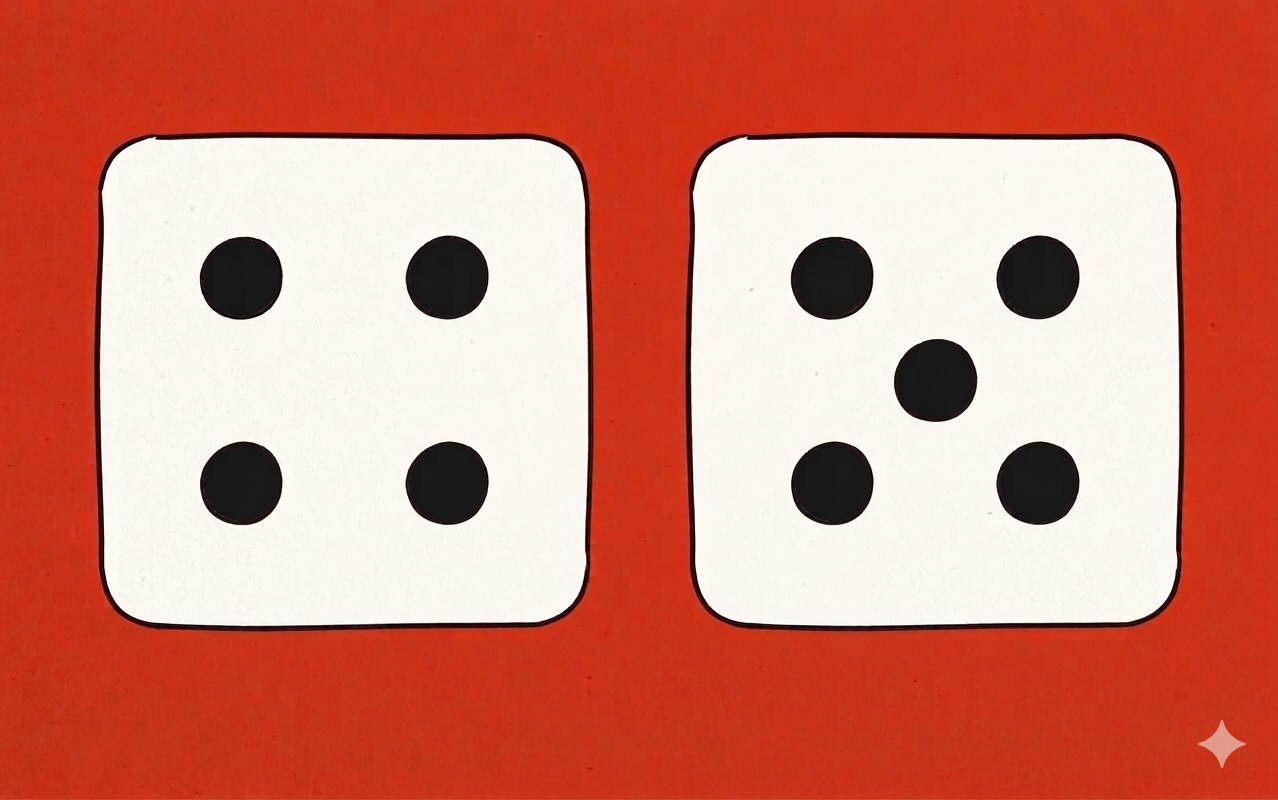

How many dots do you see? HOW do you see them?
This image appears in our Kindergarten curriculum as part of something called a “dot talk.” This is an opportunity for students to see math as something that is perceived and not simply calculated. Let’s explore what some students might notice and share.
Voices from the rug
Subitizing
Before children can count, they can already see number. Hold up three fingers. You didn’t count them just now, did you? That instant recognition has a name: subitizing. It’s built in, it’s universal, and in kindergarten, it’s where it all begins.
Children encounter the dice and read them in different ways. A child might see the four instantly, because the square arrangement is so familiar. She might see two pairs and combine them. She might see the five as another four, but with one more, counting on to confirm. These are all acts of perception and reasoning happening simultaneously, before a single number sentence is written.
From Seeing to Adding
The fluency building piece here is what the children do with the two values they’ve subitized.
“I went… one, two, three, four… and then five, six, seven, eight, nine.“
At the most basic level, a student might quantify all of the dots by counting all. This is a valid strategy for combining values. It follows the development of one to one correspondence (every object you are counting gets just one number tag) and cardinality (the last number you say names the whole group). It precedes the slightly more sophisticated skill of counting on:
“I started at five because five is bigger and then I went six, seven, eight, nine.”
Counting on means trusting that five is already five. There is no need to start over. A child who counts on has internalized something important: numbers hold.
Early Reasoning
“Four and four is eight and then there’s one more so… nine!”
Here a student is using what she knows to reason her way toward a sum. Doubles facts have a natural home on our built-in math tools: our hands. Four fingers on my left and four fingers on my right is a representation of eight fingers. A student might connect her knowledge of four plus four to what she sees on the dice. The five differs by one dot… close enough to see the relationship immediately. This is what we call a near-doubles fact. Near-doubles thinking stretches far beyond kindergarten! It’s the same reasoning that will later help her add 14+15, or 49+50.
“I made a ten in my head.”
Understanding the components of ten is the heart of additive reasoning in our base-ten number system. Here a child may notice that the four is just one dot shy of another five, and five and five is a landmark most children know well. A child who has played Shut the Box or Trouble Pop-a-Matic knows that feeling of rolling two fives. The reasoning goes: five and five is ten, but we only have four, so the sum is nine.
A dot talk welcomes every voice, because there is no one right way to see nine. Children learn new strategies from hearing each other think out loud. Math, it turns out, is as much about perception as it is about calculation.