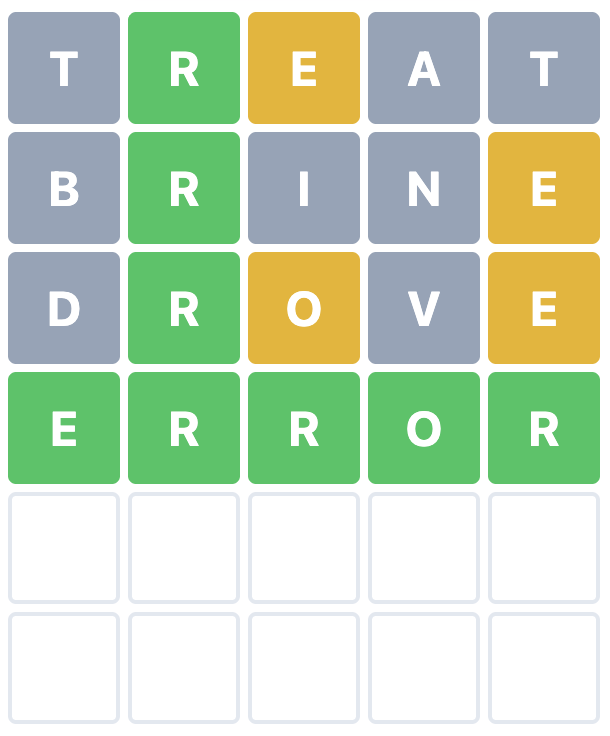

A true story
“My dad says mistakes are good,” a second grader shared. “He said they help you learn.”
We were discussing the importance of giving hard things a try, even if we don’t always succeed.
“It is sort of like playing Wordle!” She said, almost as an after thought.
“Tell me more…” I prompted.
“Well, when you play Wordle, it’s actually good to get letters wrong because then you have less letters to choose from and you can figure out the word easier.”
Out of the mouths of babes….
“Doing math” is riddled with errors. Any practicing mathematician will attest that mistakes and moments of not knowing make up a large percentage of the work. I constantly bring up Andrew Wiles, who made one of the most famous and high profile errors in the history of public-facing math when his initial (non)proof of Fermat’s Last Theorem was discovered to have a mistake within.
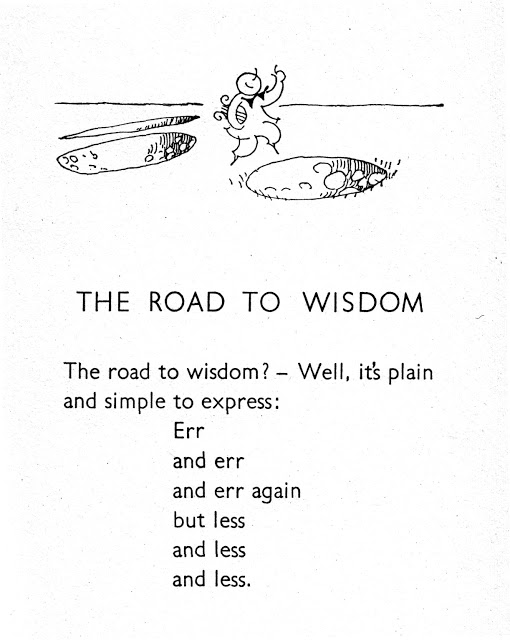
I also think of this “Grook” by Piet Hein (1905 – 1996) who was not only an inventor, designer and a poet, but a mathematician himself. He knows of what he writes:
Accept, Respect, Inspect, Correct…
Let’s take this a step further than simply being okay with and accepting of mistakes. What if we actually respected them? One of my favorite (albeit overused and frequently found on posters and coffee mugs) teacherisms on mistakes is, “in this classroom mistakes are expected, respected, inspected, and corrected.” See, there is a difference between tolerating or accepting errors and respecting them. Tolerating is a passive “it’s okay, try again, you’ll get it.” Respect requires us to stop, look closely, and ask why.
This is what mathematicians call error analysis, and it is one of the most powerful learning tools we have.
A mistake almost never lies. It shows you exactly where the understanding broke down. This is where teaching and learning turns into detective work. When a student gets something wrong, the question isn’t “what did you do wrong?” It’s “what were you thinking there?” We want to identify the point at which the wrong turn happened.
In School
Mistakes are teaching tools. The wrong answer deserves the same careful attention we give the right one–in fact, mistakes provide incredibly rich teaching material! A middle school math teacher named Leah Alcala built a classroom routine all about this idea and called it My Favorite No. She chooses one really rich wrong answer and brings it to her class for analysis. Together they determine what is right about the work and thinking before identifying where it goes astray. This routine has been adopted and adapted by many math classrooms.
In third and fourth grade, when we begin to have students reflect on their end-of-unit assessments, we teach them a sort of error-analysis lite: how to categorize errors. The categories are:
Whoopses I misread the directions, I miscopied a value, I forgot to include units in my answer.
Computational Errors For some reason 5 x 3 decided to equal 20 today? 740 + 740 = 1400! Wait, what?
Conceptual Errors What on earth is a denominator anyway? What does it all mean?
These errors are very addressable. Whoopses tend to diminish as students mature and build a greater sense of accountability for checking their work thoroughly before considering it finished. Computational errors often happen when students are still in the process of building fluency and intuition about what makes sense when working through calculations.
Conceptual errors indicate a deeper breakdown in understanding that needs to be addressed. A good analogy is taking a wrong turn on a drive you thought you knew. The scenery might seem just fine, lovely even, but you are not going to get where you need to be without turning back to find the place where you took the wrong turn and thinking through what happened. The job for a teacher in that moment isn’t to correct and continue but to slow all the way down, take a breath, and find a new way in. Big, important teaching and learning moment!
At home
At home you, too, can participate in this important part of learning. The most productive thing you can do when you’ve noticed that your child has gotten something wrong is to fight the urge to start corrective and get curious first. Ask questions: “how did you get that?” The explanation might not only help you hear exactly where the thinking is less solid, your child will often hear it too. The opportunity to explain their reasoning out loud can help kids catch their own mistakes or areas of confusion independently. That’s pretty powerful.
And if it seems to lead to a dead end? Frustrate not. That’s when you have your kiddo grab that post it note, mark it, and send it in to school for us to address. No post it notes? Draw a descriptive emoji. Send it in. Mistakes are information. Information is good. Let’s get that student back on the right road.
You are also a role model. When you need to address an error in your own life (we all make them!) resist the urge to erase it. Circle it instead. Talk about it. Name it out loud. “Oops, let me look at that again.” Or even better: “Hm, that doesn’t seem right. How can I figure out where I went wrong?” Demonstrate what a healthy relationship with error looks like!
Enough already, Ms. W
I could go on forever, you know. But let’s conclude with a few thoughts.
- Good job, dad from Wordle analogy up above. You’re making it safe for your child to make mistakes. That safety means she is more likely to be open to learning from her errors rather than shutting down or feeling less than.
- Andrew Wiles: he knew that a mistake doesn’t mean the end. To Wiles, that error was information. It sent him back to the drawing board for a time… and he returned with the final proof that earned him all those accolades that lead us to use him as a valuable example of mathematical persistence.
- The wrong answer, when accepted, respected, inspected, often becomes the right one–and that learning process is major.