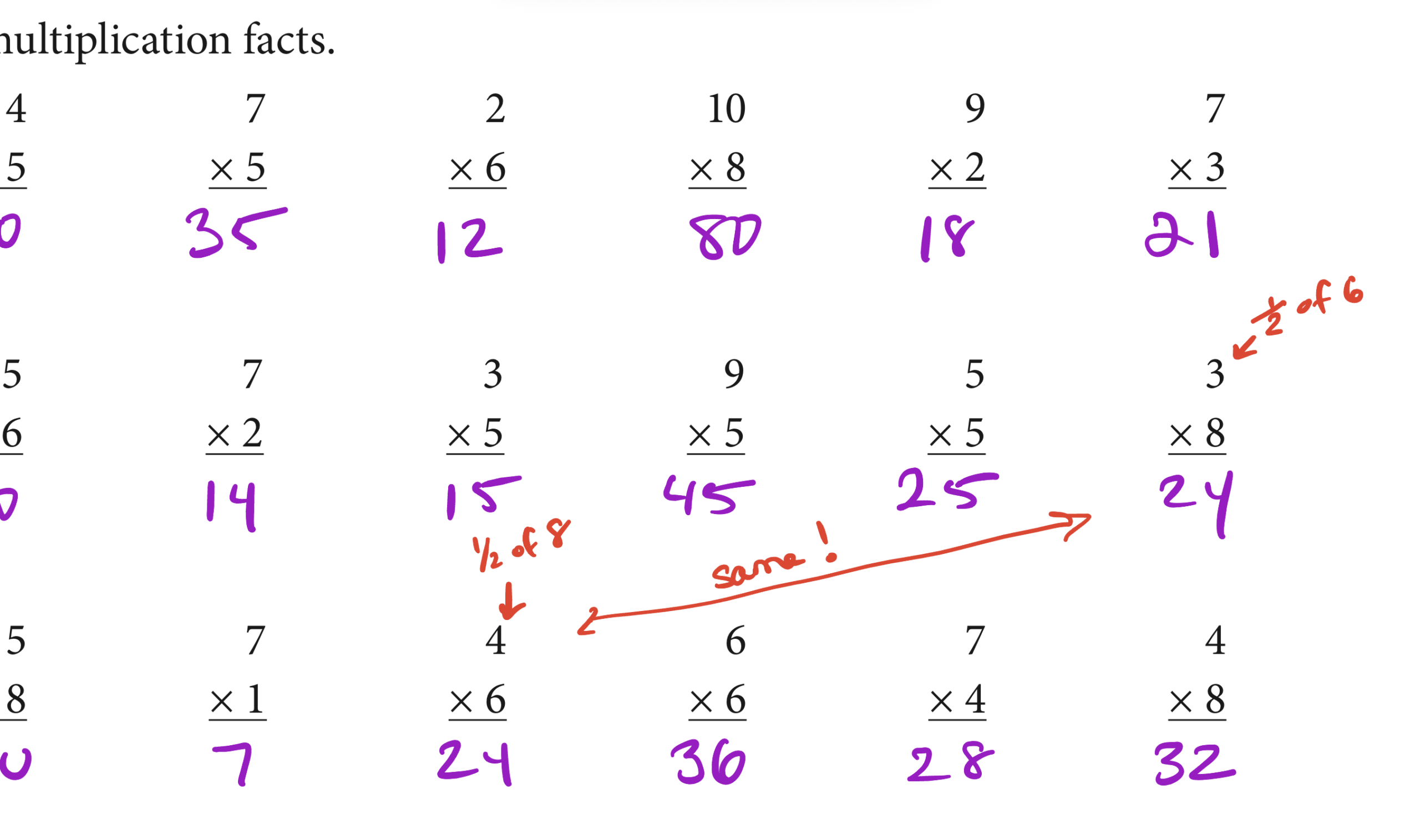

When a student is used to scrutinizing the values she is working with, the connections emerge. Often the kids are so excited to share the connections they’ve made that they annotate their math homework or burst into an excited monologue in class. These are the gems we love to see as math educators, and it is not hyperbole to say that these are the same gems the ancient Greeks, Egyptians, and Babylonians discovered as they “invented” math. Math education, after all, allows students to discover for themselves the properties they will grow to take for granted as they build their facility with algebraic thinking.
One recent example I noted on a third grader’s homework was a moment of excitement about the connection between 8 × 3 and 4 × 6. Both share a product: 24. This fact inspired this student, who is busily learning her multiplication facts, to wonder “why?” She then noted, with arrows and annotations, that 4 is half of 8 and 6 is double 3. Something to mull over.
What she may not realize is that she just discovered the multiplicative truth of doubling and halving. If you halve one factor and double the other, you retain the same product. What is really happening? Here is a visual:
The next question I might ask this student is, "will this always hold?" And we will try lots of different expressions in order to explore this as a generalization. Eventually perhaps we will substitute variables for the numbers (we consider variables in this case to stand for "any number") and discover why this is provable (if you half one factor, but double the other consider how that is connected to the multiplicative identity, or multiplying by 1?).