
“Use the math you know.”
It is one of my most important mantras. In fact, I rarely have to say it anymore. When I review an upcoming homework assignment with my students, and we come to a tricky looking or non-routine word problem, maybe one that is pre-labeled as a “challenge” (and now for a digression: that label might shut a student down before she even tries, and I may write more about that later… digression within digression: I appreciate the approach of one of my students who crosses out the “challenge” label before she even reads the problem, because she doesn’t want to be psyched out), I ask the students, “Now what am I going to say about tackling this one at home?” and the kids say all at once, “Use the math you know.” (You will have to imagine the singsongy we-hear-this-all-the-time chorus.)
But it is important. Here’s why.
Let’s talk about our intentions as caregivers of our children (and I count myself as a part of this crew, because I am a mom of two young mathematicians!). We love our kids and we want them to feel successful. We are home. Dinner is over. And the homework is just not quite finished, because of that… that challenge problem. Often it is a word or story problem–or some directive to a tricky calculation. So we settle in to help. After all, bedtime is nigh and emotions are getting high and this night needs to end smoothly. So the well-meaning adult reads the problem. How hard can this be? I just need to teach my first grader a little long division and we’ll be done with it! Or: my third grader just needs to set x equal to y and solve… easy.
The trouble is, we’re looking at the problem through our adult lens–one shaped by decades more math than our student has yet encountered. The way we know how to solve it most likely bypasses the math toolkit she is currently working with. Asking (or sometimes telling, even, right?) our student to do it our way can be like asking a child who just learned to ride a two-wheeler to race a motorcycle. The motorcycle is faster, sleeker, and quite frankly cooler… but she hasn’t done drivers’ ed and doesn’t have her license yet. We need to let her use the vehicle she actually knows how to operate, and trust that it can get her from Point A to Point B. (In fact, we might need to learn how to ride a bike again, her way.)
So how can we help our student? How can we let our students help us help them by calling upon the math they know?
Our job is to help our kids really dig into what is happening in a problem or context… or to take some time to notice what is interesting about the values we are working with in a calculation. This is a form of noticing and wondering, and it helps our mathematician to build enough understanding to know where to reach in her toolbox… Even if that toolbox is at that moment full of inefficient strategies we would never consider using. Strategies will evolve. Eventually our student will look at a “division” problem and realize she has a new and efficient way to approach it, or a pair of equations and think to herself “that reminds me of that problem with Mrs. Jones and her ducks and sheep in second grade.”
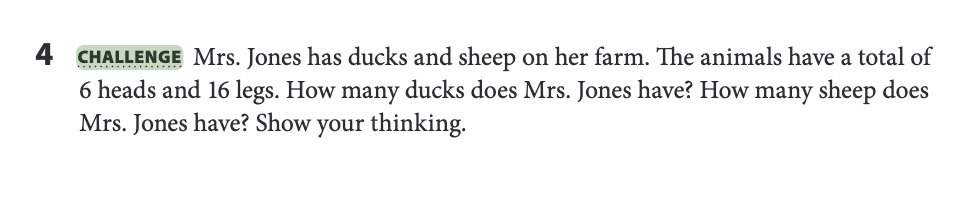
Full disclosure: That ducks and sheep thing really happened…. Except it was me having the revelation, having taught a 2nd grade challenge problem, and after sitting in on an 8th grade algebra class this winter.
Thus begins a series that will help us see what “use the math you know” looks like in action: different problems, multiple approaches, many age groups. Let’s learn directly from the children (and some brave adults) how to put this into practice.