

Recently, I’ve been hearing a lot about how AI has just sort of made mincemeat out of some of the Millennium Prize problems. I’ve also been listening to some podcasts and reading articles in which mathematicians who have literally spent their entire careers trying to solve these problems are reacting in various ways to the fact that a huge part of their life’s work has been fundamentally changed in the span of 48 hours, or however long it has taken. There is a mixture of absolute heartbreak and some tentative excitement.
A couple of the things have stood out to me are:
The heartbreak comes from this: when someone spends thirty years working on the same math problem, the work stops being a task or means to an end and becomes instead the place where they exist. Their passion is working through something slowly, methodically, carefully, and discovering many, many other things along the way, in the hopes of getting to some sort of conclusion about a problem that likely leads to more questions and propels a thinker forward to the next thing.
Some may think an answer is worth celebrating, regardless of how it is achieved. But others would argue that when it is achieved by a computer/AI, the loss of process is too great a price to pay, because the process of puzzling toward an answer is what ignites and intrigues the human brain.
In one interview I listened to on the subject, a mathematician said something along the lines of, “The thing you have to remember is that problems don’t write themselves.” It takes a human to come up with the puzzle or the problem that will be wrestled with for however many years. And to come up with that puzzle or problem, the human must formulate a really compelling question. Does AI have the ability to be curious, or is true curiosity reserved for the sentient?
What I hope for children who are learning math is that they will not always think that the ultimate goal is an Olympic speed walk to an answer. I hope that they will learn instead how to slow down and ask big questions along the way. It is why we emphasize the equivalency meaning of the equal sign before children internalize it as the same as a question mark at the end of a sentence. I think a really valuable lesson for kids who are studying math is to understand that it’s not just about computation, and it’s not just about getting an answer. It’s about getting to a place where you’re able to pose the problems that you want to solve in the first place.
One example of this comes from the classroom last week, when we were looking at a multiplication context that I’ve pasted below.
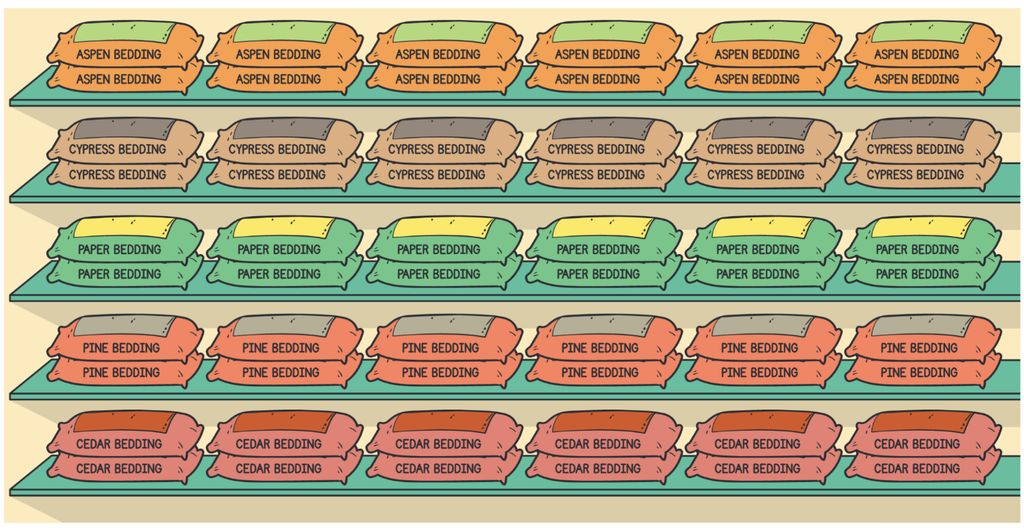
Bear with me on the fact that in the curriculum we’re currently situated in a pet store where things are priced and organized very… multiplicatively.
Several students looked at that picture for a brief moment, and they said immediately, “I know the answer. Easy. I know it,” slamming the door on the richness of a discussion that can emerge from exploring the algebraic properties within this image (find the doubling, find the powers of ten, find the distributive property, the associative property).
I said, “Okay, but I also know the answer, and the answer is 60. There are 60 bags of hamster bedding, and get this: I don’t care about that answer. What I want to know is how you saw the picture. How did your brain quantify the bags of hamster bedding?”
To the puzzled looks (she just told us the answer??) I continued, “The thing is, this child’s brain is going to think of it one way. This child’s brain is going to think of it in a different way. And this child’s brain is going to think of it in a completely different way. I’m really interested in hearing the different ways you thought about it. I bet you guys are going to be surprised at hearing the different ways your classmates thought about it, because it is understanding those multiple different approaches and the way people visualize things and put things together that makes us richer as a group of mathematicians. Nobody is an island. No mathematician works alone.”
Then, I heard a cacophony of snores and saw that I had put 12 third graders to sleep while perched upon my soapbox.
My point is that AI didn’t just pick up these Millennium problems and say, “Oh, I have all the information. I’m going to solve them.” It had to draw on years and years of other solutions to other problems that were posed and shared by human mathematicians. AI must draw on knowledge that has been created and practiced by humans in order to apply it to other things. In a way, maybe the AI that tackled those problems is proof of a collective human endeavor, but on a grand scale which is nearly impossible to achieve. In a way, it represents collaboration between mathematicians around the world and throughout history; their contributions to the art and science were simply compiled and leveraged by this super robot.
What I hope and wish for, and what I teach for, is the perpetuation of the human process; the curiosity about the universe and then the generation of the questions and puzzles that math can somehow untangle; the commingling of many organic brains and approaches that is unique to us. And that starts now, in elementary school, by pushing past my students’ desire to see “the answer” as an endpoint and therefore proof of skill or success. If answer as endpoint were truly the goal, now that the Millennium Prize problems are being solved, where would we go next?
“Why A.I. Has This Mathematician in Tears.” Hosted by Rachel Abrams, interview with Steven Strogatz. The Daily, The New York Times, 14 Oct. 2026, https://www.nytimes.com/video/podcasts/the-daily/100000011211514/why-ai-has-this-mathematician-in-tears.html.
“AI Is Steamrolling Through Math. Why Does That Matter?” Hosted by Meghna Chakrabarti, interviews with Steven Strogatz, Hugo Duminil-Copin, and Francis Su. On Point, WBUR, 13 Oct. 2026, https://www.wbur.org/onpoint/2026/10/13/ai-steamrolling-math-solve.