
Sometimes the best definition is so brief and obvious…if you were to ask me just yesterday how to define fact fluency I would have given you a mouthful of alphabet soup teacher-ese. This morning, over coffee, shuffling through some of my favorite math education books as one does, (this time Marian Small’s amazing tome for math educators, Understanding the Math We Teach and How to Teach It) it occurred to me that Small’s definition of fact fluency is just so obvious and accurate: “to both know the facts and to understand them.” Duh. This is basically what I’ve been trying to surface for years but knowing my verbosity…
Knowing the facts implies the quick and accurate recall piece of fluency, which yes, is very, very important for students. One reason it is important is because of cognitive load–before a student is fact fluent, she expends a good deal of her mental power searching for an accurate sum, difference, product, or quotient. Once those facts are good and learned and tucked away into the filing cabinet of her long term memory, she can retrieve them at will and all of that working mental power is reserved for the more complex problem solving.
Now, when a child is just developing familiarity with numbers and quantities (see posts on counting and developing addition), or just learning the ins and outs of a new operation (like moving from additive fluency to multiplicative) she should expend that mental energy on piecing numbers together strategically. The work of developing fluency is in itself a form of complex problem solving and meaning making for her at that point. This is the understanding piece of fact fluency.
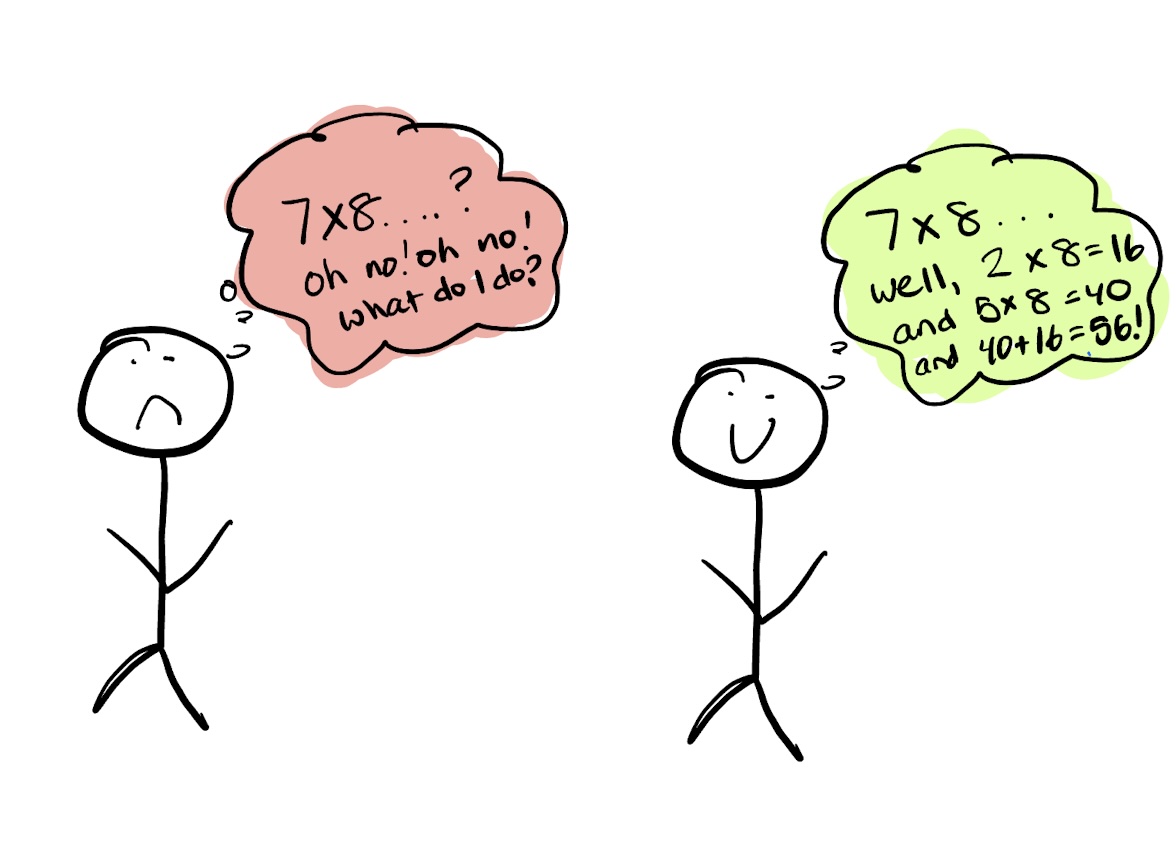
A student needs to build fluency strategically in order to understand it. Memorizing digits and symbols in the abstract only builds a very superficial and limited knowledge of number facts. Strategic development of facts helps a student leverage her understanding of number composition and the behavior of operations in order to construct each fact and apply that understanding and those patterns to larger values. Here are two illustrative scenarios:
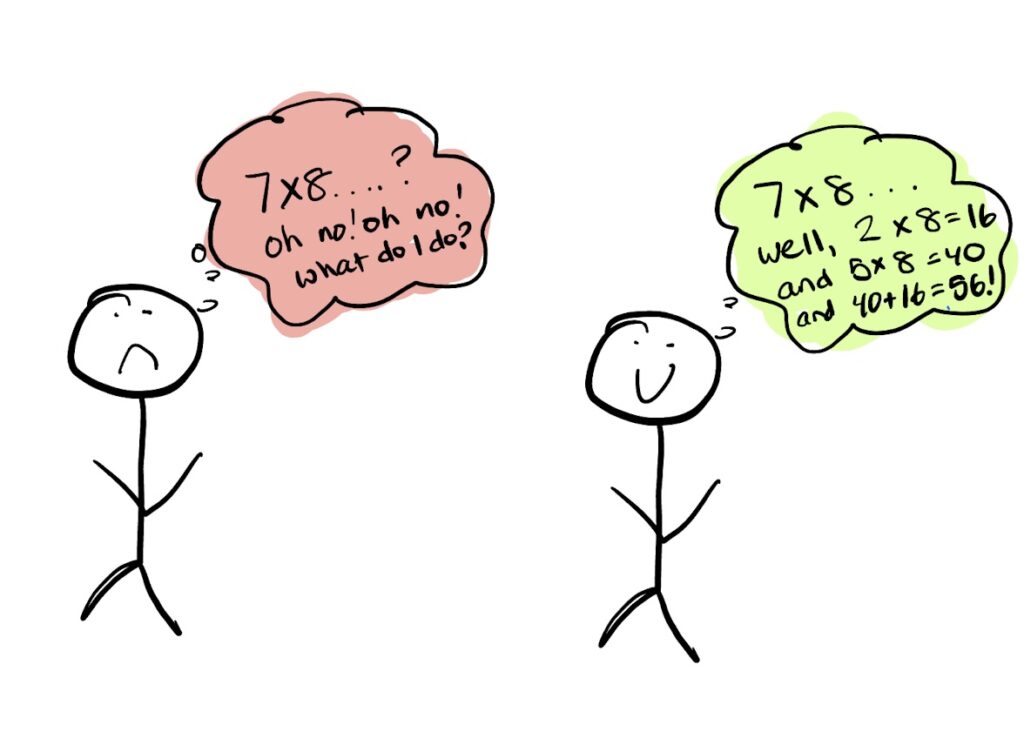
The more practice a student has generating and practicing her facts, the more likely they are to be tucked into that long term memory filing cabinet–but the more she understands her facts the more likely she will be to catch herself, intuitively, when she makes an error (hmm 7 + 7 can’t equal 15, because doubles generate even numbers!), and best of all… she won’t get stuck… (7 x 8? oh gosh I forget that trick I learned, what was the rhyme again? oh well, I know 2 x 8 and 5 x 8, those are easy for me, I will just combine them, 16 + 40 = 56, no big deal!).
It is important to note that levels of fluency inform other levels of fluency. So in the above example, the students had to develop awareness of “easier” facts in order to make sense of the “harder” facts they were working to decipher. That is why we take students through a very intentional sequence of fact development. To call upon the building analogy I love so much, students need to start with foundational fluency in order build stronger and more meaningful fluency across the board.
[…] it finished. Calculation errors often happen when students are still in the process of building fluency and intuition about what makes sense when working through […]