

Math (and Time) Is All About Magnitude
Once you master foundational facts within 20, you conceptually possess the keys to the entire base-ten kingdom. Our positional number system is purposefully constructed so that a basic grasp of small quantities is all you ever truly need to compute… anything. “Largeness” is just the cloak digits wear to look big and scary. A six-year-old who knows how to add 7 + 2 basically already has all the math rules they need to file your taxes. Algorithmic multi-digit arithmetic is just the same old single-digit steps repeated ad nauseum. The mechanics never actually change, only the number of digits (and place value columns). The point is, two big numbers stacked up and added are no more complex than a basic fact. The complexity and the real, rich math, lies in training the brain to understand the magnitudes involved.
I’m groping my way through a fascinating (and very dense) book by cognitive neuroscientist Stanislas Dehaene called The Number Sense: How the Mind Creates Mathematics.
Dehaene writes about the fact that the human brain naturally maps numbers along an internal or mental number line. The wild thing about this is that the number line is neither linear nor proportional, it’s logarithmic. Close your eyes for a second (when you’ve finished reading this of course) and picture the numbers 1-10 on a number line in your head, all mapped out and neatly and evenly spaced. How nice. Now travel down that number line and check out 1,000,000 and while you’re at it plot 1,000,000,000.
It’s likely the space between 1 and 2 is quite airy and comfortable while the absurdly high magnitude values are all smooshed together way up there in the distance, hard to map or decipher. The large numbers feel, to the brain, weirdly close to each other.
Why Time Flies … for Adults but not for Six-Year-Olds
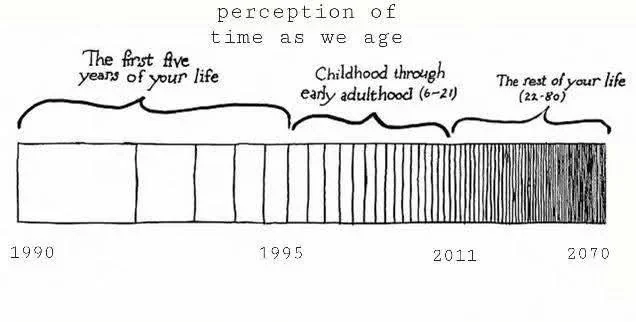
This same idea, this mental slinky, explains the mystery of how we perceive the passing of time, something I think more and more about as I thrive my way through my 40s. Why do the years seem to just fly by, and why can’t I remember anything anymore?
To my seven year old, a single year represents a 1/7th of his existence. To me, that same year is a tiny 1/44th. It is why 18 years have somehow zipped by since I started teaching at Nightingale. In my mind, I look the exact same age, yet my very first students are now impressive young professionals. The years didn’t actually speed up; my accumulated life experience just expanded, so my sense of time compressed. I just learned, while writing this post that that concept has a name: Janet’s Law, as visualized in the below diagram.
Which brings me back to math education…why is magnitude the more valuable concept? Why does it trump the rote mechanics?
Without a proper sense of what a number is worth……
- We lose our math “gut check.” Magnitude is a big part of that, “Wait, that answer makes zero sense!” alarm. Without it, a misplaced decimal point or an additional (or missing) zero can cause major real life issues.
- Fractions turn the old “rules” upside down. Kids get thrown for a loop when they hit fractions because 8 is bigger than 2, so shouldn’t 1/8 be bigger than 1/2? Without a picture of relative size in their heads, fractions are just weird looking numbers they hope to survive with a lot of cute tricks and mnemonics. In reality, fractions are quantities, and to truly understand them and how to operate with them they need to be understood as such. One of my favorite things about introducing the idea of rational numbers to my students (many third graders can handle this idea right in September, or at least they told me they got it) is totally throwing off their idea of what is infinite. Infinity is not just a horizon of hugeness, it’s also the incomprehensible minuscule of the forever in between space.
- News headlines lose all meaning. Without a sense of scale and context, a million dollars, a trillion-dollar budget, and a 0.01% risk are hard to decipher. We are also susceptible to manipulation by sneakily presented data.
Clearly, it’s a pretty important topic that deserves attention starting at a young age, which is why as educators we are very deliberate in building an accurate sense of magnitude in our students. Some of the ways we do it:
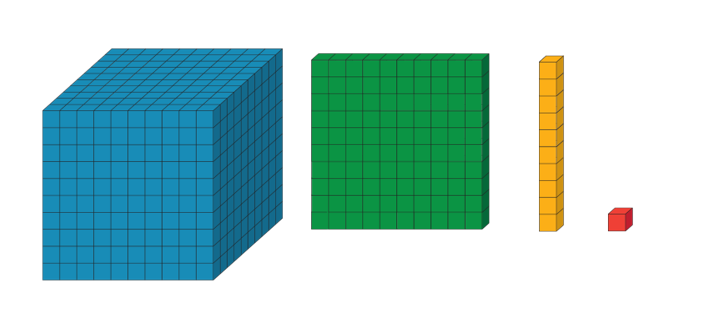
Base-Ten Blocks: Allowing students to physically see and feel a single unit grow into a rod (10), a flat (100), and a cube (1,000). We bring these out in a variety of forms from first grade onward.
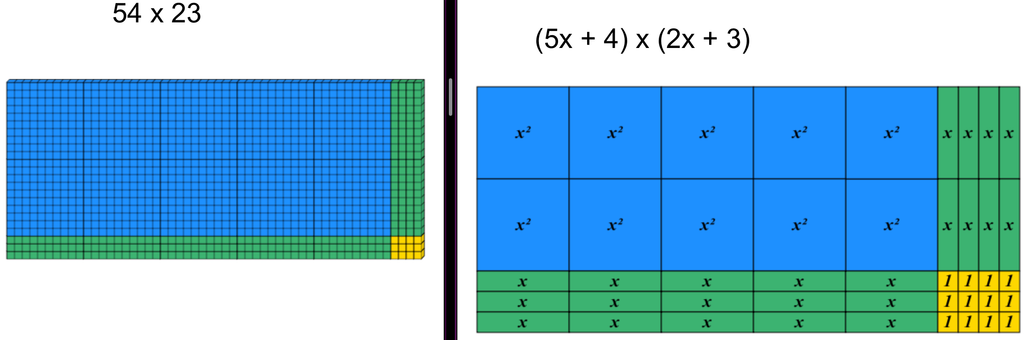
Proportional Area Models: When we explore multiplication via area models (which happen to be a crucial precursor to 8th grade algebra concepts) we are sticklers for creating the model proportionally. It helps students physically see how quantities scale relative to space.
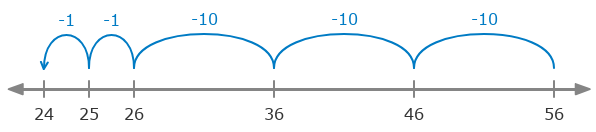
The Linear Number Line: Intentionally retraining the brain’s internal map to space 100 as far from 200 as 0 is from 100. We work frequently on the number line, developing that sense of magnitude, proportionality, and scale as well as strengthening estimation and rounding skills. Remember, today’s number line is tomorrow’s x-axis.
Growing that sense of magnitude takes time. And it should, because we’re talking about developing brains here.
Kindergarteners make the huge cognitive leap of bundling ten 1s into a single 10 (how can ten things become one thing?!). First graders take those 10s and bundle ten of them to build a 100 (one thing is ten things AND 100 things?). Second graders extend that into the 1,000s and so on. In 4th grade, you should see the insanity of the Great Wall of Base Ten which, through the hard work and lots of cutting and gluing, turns abstract place value into a scalable model of reality. And then they go the opposite direction and slice and dice that tiniest unit into ten tinier ones…how tiny can they go? I remember a student vowing to go home with a unit square over the weekend and return with ten thousandths.
Trick or Treat
In short: “big math” is just small math’s Halloween costume. The goal of math education isn’t training kids to perform rote routines. We are rewiring the brain’s mental number line so they can clearly see the real and true scale of numbers… and time… and really, the world.