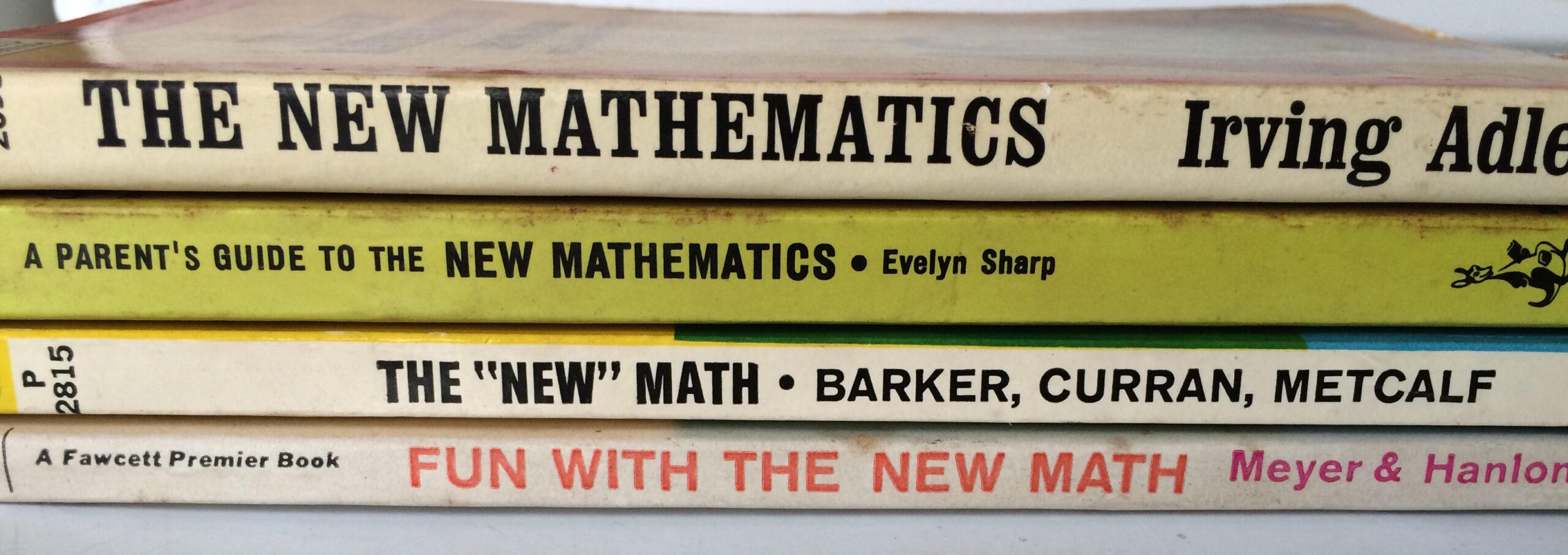

Sometimes the math looks different from what most of us remember, and if you’ve sat down to help with homework lately, you know exactly what I mean.
You come to the table ready to be useful, and the page is full of… number lines? Little boxes? An invitation to “make a ten,” to “show your thinking,” to solve it another way when she already had it the first time? Where is the math we learned?
Your reaction is reasonable. And your child is okay.
The math you learned was just the phonics
Think about how we learn to read. First come the mechanics: the letters, the sounds, the sounding-out. A child can decode every word on a page—c-a-t, cat—and get every one of them right, and still have no idea that the story is sad, or funny, or about her. Decoding isn’t reading. It’s the doorway to reading.
Reading, the real thing, is the movie that starts playing in her head. It’s living inside the story, arguing with a character, gasping at a twist, predicting an outcome, and hauling the book around because she can’t bear to put it down. A child who can vocalize every word but take in none of it has learned to read… but not read; we’d say she can decode, but then we’d get her to a place where it actually means something. That meaning, that magic, would be a non-negotiable.
Math is the same, and unfortunately many of us were only ever taught the phonics. We learned to sound out the steps, line up the numbers, borrow from the tens, keep-flip-change, bring down the five, carry the one, and out came the answer whether or not any of it meant a thing. We got very good at decoding math devoid of meaning. Most of us never got to the can’t-put-this-book-down magic.
So when the homework looks different or asks things in a way that feels unfamiliar, it is positioning your child to reach for that magic. Our hope and dream is to help your child become a mathematician. Not a child who can only sound out the steps, but one for whom the math actually means something, who can look at a problem and see the numerical story inside it.
And, to be clear, the mechanics still matter enormously. Just as no one delights in a novel while working overtime to sound out every syllable, it is very difficult for a child to think flexibly or creatively about a problem while she’s still counting to solve 7 + 8. Fluency is the decoding that frees her up for the story; it’s just not the destination, it’s the doorway.
A Doorway: One problem, two ways
Take 63 − 28. The way we learned it, you stack the numbers, try to take 8 from 3, can’t, borrow a 1, cross things out, and hope for the best. It works, and it tells you almost nothing about what 63 − 28 actually means.
Now watch a second grader do it on a number line:
Watch her flip the subtraction to addition with a missing addend (helllllo algebraic thinking!). Come along for the journey. She starts at 28. Hops up 2 to land on a nice round 30 (a multiple of ten is desirable real estate). Takes a big, friendly jump of 30 (three tens, like skip counting) to reach 60. Then, so close to her final destination, just 3 more to land on 63. And adds up her hops: 2 + 30 + 3, which is 35.
She made the numbers work for her, with no borrowing and nothing crossed out; and if you ask her how she knows she’s right, she can tell you, because she made every one of those choices on her own…
(And yes, the old standard algorithms still get taught, just after the understanding, not instead of it. A procedure built on a foundation lasts; a procedure built on “just do the steps” holds up beautifully… until it doesn’t (fractions, anyone?).
You already do this.
To be clear… The “new” way isn’t new. It’s the thinking you do all day long, in your head, on the move, with no time to write a single thing down. You hold three variables in your head: the traffic, the gas gauge, the clock, and make a decision under uncertainty with no time to be sure: you’ll make it, but you’re not stopping for coffee (ouch). You sense a price is off in the cereal aisle, form a conjecture, test it against what you know about ounces and dollars, and convict the Family Sized box of being a lie (you’re no deal, sir!). That is the entire architecture of mathematical thinking.
“Real” math was never executing a procedure someone handed you; it’s the reasoning underneath. It is building the argument, trusting your judgment, taking what you know and using it to unravel what you don’t. You do it improvising dinner for six out of a meal meant for four (they didn’t tell you they were bringing friends). You do it every time a claim doesn’t add up and you go looking for why.
None of it feels like “math,” because it shows up without symbols and unexpectedly. But estimating, inferring, weighing the evidence, leaping from what I know to what I can therefore figure out… that’s the real thinking. It’s exactly what your daughter is learning to do on that number line.
Three moves for the kitchen table
Ask her to teach you. “Wait, show me how that number line works, I never learned it this way.” Explaining is hard mathematical work, and kids love being the expert.
Ask the one question that fits every method: how do you know that’s right? It works on the number line, on the old stacked algorithm, on a method she made up in the grocery store. The method was never the point; the knowing is.
Don’t prize one methodology, whether it is one being taught at school versus one you often do at home. If both roads get her there, let her keep both. And if math scared you once, make the effort to keep it light: kids catch our tension, not our rusty arithmetic. You don’t need to be a math person (even though I’d argue you are…). You just need that kitchen table to feel safe.
The bottom line
Maybe math looks a bit different because it’s finally showing its work, bringing the thinking (that was always there, underneath the steps) out into the light. Your child isn’t learning a weirder math than you did; she’s learning a more honest one, and getting to feel the small thrill of figuring something out for herself, the one school mostly trained out of the rest of us.
You don’t have to relearn a bit of it. Just ask her.
Want the blog to come to you?
Get new content delivered straight to your inbox 2x a month — including: