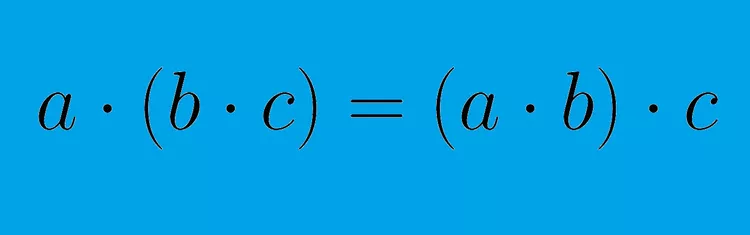

Today we briefly talked about something I’m not going to name for the students just yet, because we are still playing! We’re on a cliffhanger until Monday. We left this unresolved for now…
What I can tell you is that we looked at 3 × 4 × 5 and took a moment to solve it independently. When I asked students what they’d multiplied first, a great number of them were left-to-righters, solving 3 × 4, then multiplying the resulting 12 by 5. One student noted she’d started with 4 × 5 and multiplied 20 by 3.
Notice how the answer stays the same, no matter which factors you address first. It all comes down to personal preference, we decided. Would you rather multiply 12 x 5 or 3 x 20? A third student even noted you could shuffle the whole thing up because we understand the Commutative property: “Well, it doesn’t matter what order we multiply in, so you could do 3 × 5 first and multiply 15 by 4.”
This all got my teacher brain thinking about things we adults take for granted without a deep-dive. See, this is the math that helps explain something students already know but may not have clearly articulated a reason for yet: the reason you can “add a zero” or a few when you multiply a single digit by a multiple of ten. The kids generalize that process and conclude that you can simply solve for your basic fact and then, as the kids say, “add a zero.”
Here’s why it actually works: 70 is the same as 7 × 10. So 4 × 70 can be rewritten as 4 × 7 × 10. Solve 4 × 7 first, get 28, and then 28 × 10 is just 28 groups of ten. A cool 280. This is what unlocks multi-digit multiplication!
And there’s more!
And if you really want to get snazzy with the associative property, consider 16 × 18. You could see 16 as (2 × 8), and 18 as (2 × 9). That means when we multiply 16 x 18, it is equivalent to multiplying 2 × 8 × 2 × 9. Change the order of those small and friendly factors, and we get 2 × 2 × 8 × 9. Solve the brackets: 4 × 72. Double 72 to get 144, double again to get 288, because we know our fours are double doubles!
SO fun to puzzle through and we’ll have a name for all of this on Monday. The third grade is realizing that just like their basic addition and subtraction facts and their awareness of place value set them up for success when working with multi digit calculations, their basic multiplication facts set them up to basically conquer the world!